2026-09-09
Post-Care Guide from an Apgujeong Mole Removal Dermatology Clinic
Discover essential mole removal aftercare instructions from an Apgujeong dermatology clinic to prevent scars, promote proper wound healing, and avoid pigmentation issues effectively.
Post-Care Guide from an Apgujeong Mole Removal Dermatology Clinic

Hello, this is DM Dermatology Clinic. No matter how small a mole may be, neglecting post-care after pigment removal can increase the risk of scarring or hyperpigmentation. Today, we will explain mole removal techniques and the essential aftercare precautions to keep in mind. Moles consist of melanin pigment cell clusters within the skin, and nowadays, advanced lasers are commonly used to remove them. Different lasers emit specific wavelengths or offer precision ablation, allowing us to select the most effective device based on the characteristics of the mole.
When removing a mole with a laser, slight damage to the surrounding healthy skin tissue can occur alongside the mole itself, making diligent wound management crucial.
Can I remove many moles at once? Can large moles be removed?
Because each mole is an independent lesion, removing numerous moles simultaneously is not inherently problematic—in my personal experience, I have removed up to 200 at once. However, when multiple moles are clustered within a small area, there is a risk of insufficient healthy tissue remaining for proper wound healing, so treatment may be divided into two or three sessions. While standard moles can generally be treated all at once, removing an excessive number across the entire body can complicate daily aftercare routines, such as washing your hair or showering, even if the procedure itself goes smoothly.
Using laser treatments for mole removal in Apgujeong allows us to eliminate large facial moles—even those up to 10 mm—with minimal to no scarring. Raised moles, hairy moles, and intensely pigmented moles can also be removed safely. For these atypical moles, accurately anticipating the depth of the root is critical to prevent recurrence or residual pigment, ensuring optimal treatment satisfaction.
What are the 3 key steps to prevent scarring after mole removal?
To prevent scarring after mole removal at our Apgujeong clinic, you must strictly observe these three principles. First, keep the area moisturized. Allowing a healing wound to dry out significantly raises the risk of scarring, so maintaining moisture is key.
Second, ensure occlusion from external elements. You must shield the wound from external bacteria, irritants, and water to create an optimal environment for natural skin regeneration.
Third, apply sun protection. Intense UV exposure irritates freshly renewed skin following mole extraction and can easily trigger post-inflammatory hyperpigmentation.
Guidelines for Hydrocolloid Dressing Tape and Ointment Use
Commonly used hydrocolloid healing dressings (such as Duoderm) provide moisture retention, occlusion, and UV protection simultaneously. Applying this dressing immediately after mole removal and keeping it on until tissue re-epithelialization is complete will allow the skin to heal cleanly without scarring.
For areas where applying tape is difficult—such as around the eyes or mouth corners—you should frequently apply an antibiotic ointment to keep the wound moist and prevent it from drying out.
You do not need to apply antibiotic ointment or regeneration cream under the dressing tape. Hydrocolloid tape alone offers sufficient hydration, occlusion, and wound protection; applying ointments or creams underneath can hinder adhesion, so using the tape on its own is recommended.
Managing Complications and Preventing Recurrence
Even with meticulous care, some patients may experience hyperpigmentation, minor scarring, or residual redness. These issues can be improved using targeted dermatological lasers. If you suspect any complications, schedule a consultation with your treating physician or a board-certified dermatologist for an appropriate solution.
While we strive for complete removal in a single session, there is no infallible technique that guarantees a mole will never return. Due to the regenerative properties of skin tissue, partial recurrence can occasionally happen. When a mole reappears, performing a safe secondary removal with minimal scar risk is essential. For this reason, choosing an experienced board-certified dermatologist in Apgujeong is paramount for satisfying results.
The Most Important Principle for Recovery After Mole Removal
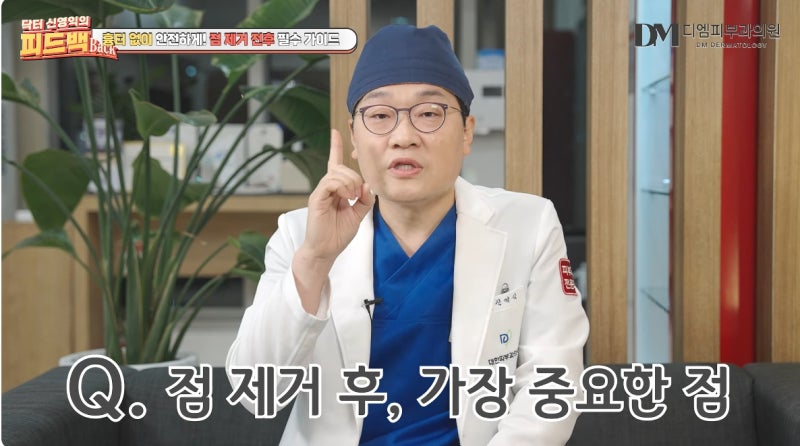
The golden rule of aftercare following mole removal in Apgujeong is to let the wound heal naturally—meaning you should not interfere with the process. To achieve this, avoid the following:
First, refrain from touching or picking at the treated area. Avoid changing the hydrocolloid tape too frequently or letting water seep in, as a lifted patch can lead to infection. Even if the dressing is waterproof, moisture can enter around the edges, so exercise caution. The most crucial factor after mole removal is leaving the site undisturbed until it heals cleanly. Secondary infections or inflammation dramatically elevate the risk of hyperpigmentation and scarring. Keeping the occlusive dressing properly attached for about a week is critical.
Second, avoid lack of sleep, extreme fatigue, poor nutrition, and excessive dieting, as these can impede optimal skin regeneration.
Mole removal is not a procedure that should be done haphazardly just because it is inexpensive. Some believe that if a cheap treatment results in recurrence, they can simply get it removed again. However, repeated removals on the same spot compound the risk of scarring and pigmentation irregularities. Precision during the initial treatment paired with thorough post-care remains the most reliable strategy to minimize scar risks. Laser mole removal demands intense focus and expertise; it is not a casual, low-cost procedure that anyone can perform effortlessly.





















Frequently Asked Questions
Is it safe to remove multiple moles at once?
Yes, removing many moles simultaneously poses no medical danger in itself. However, if multiple moles are concentrated in a tight area, sessions may be staged to ensure proper skin regeneration. Removing too many all over the body at once can also make daily routines like showering slightly inconvenient.
Can large or raised moles be removed with a laser?
Yes, large moles up to 10 mm as well as elevated moles can be removed. Unique lesions with hairs or deep pigmentation can also be treated with minimal scarring, provided that root depth is accurately evaluated beforehand to reduce recurrence and scar risks.
Should I apply ointment along with hydrocolloid recovery tape?
No, you do not need to use both together. Hydrocolloid tape provides sufficient moisture, sealing, and wound defense. Applying ointments or creams beneath the tape weakens its adherence, so using the patch on its own is recommended.
What habits should I avoid to prevent scars after mole removal?
Avoid picking at the wound or changing the dressing tape too frequently. Water infiltration or secondary infections substantially increase scar risks, so leave the patch in place for roughly a week and avoid physical exhaustion, poor sleep, and strict diets.